Comparative Analysis of Fuzzy Analytic Hierarchy Process and Interval Analytic Hierarchy Process for Multi-Stakeholder Evaluation of Public Transport Supply Quality
DOI:
https://doi.org/10.59543/a5ctzq55Keywords:
Multi-Criteria Decision Making (MCDM), Fuzzy Analytic Hierarchy Process (FAHP), Interval Analytic Hierarchy Process (IAHP), Stakeholder Analysis, Public Transport Quality, Kendall’s Coefficient of Concordance (W), Urban MobilityAbstract
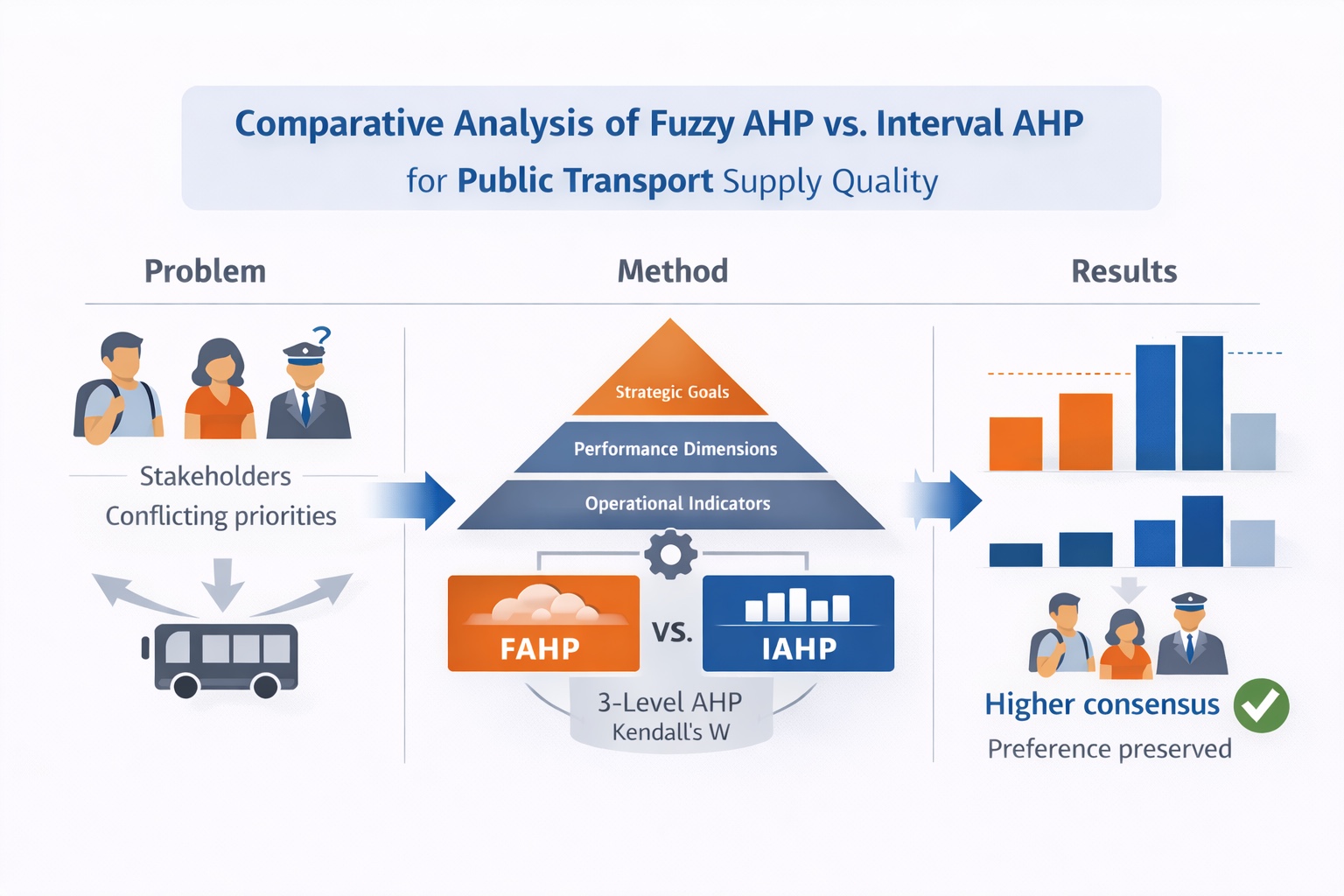
Evaluating public transport service quality requires balancing diverse stakeholder perspectives, a complex task essential for sustainable urban mobility. The efficiency of Multi-Criteria Decision-Making (MCDM) techniques, such as the Fuzzy Analytic Hierarchy Process (FAHP), in fostering consensus among diverse groups is still up for debate. This study compares FAHP and Interval AHP (IAHP) to determine which method better achieves stakeholder agreement in public transport quality assessment. Using a three-level criteria hierarchy, data were collected from regular passengers, potential passengers, and government officials in Mersin, Turkey. Both FAHP and IAHP derived priority weights, with consensus measured by Kendall’s coefficient of concordance (W). Results revealed that consensus was strongest for strategic goals and weakened for operational details. Notably, IAHP consistently outperformed FAHP, producing higher concordance across all levels. The findings demonstrate that IAHP is a more effective tool for reconciling divergent preferences, offering transport planners a superior method for fostering legitimate, consensus-driven policies and improvements.
Downloads
Published
How to Cite
Issue
Section
License
Copyright (c) 2026 Hiba Solieman, Szabolcs Duleba (Author)

This work is licensed under a Creative Commons Attribution 4.0 International License.