Physics-Informed Machine Learning for Predicting Thermomechanical Stress in Rotating Carbon-Aramid Hybrid Composites
DOI:
https://doi.org/10.59543/rpwq1n92Keywords:
Hybrid Composite Structures; Machine Learning; Predictive Modeling; Thermomechanical Stress Analysis; Von Mises Yield CriterionAbstract
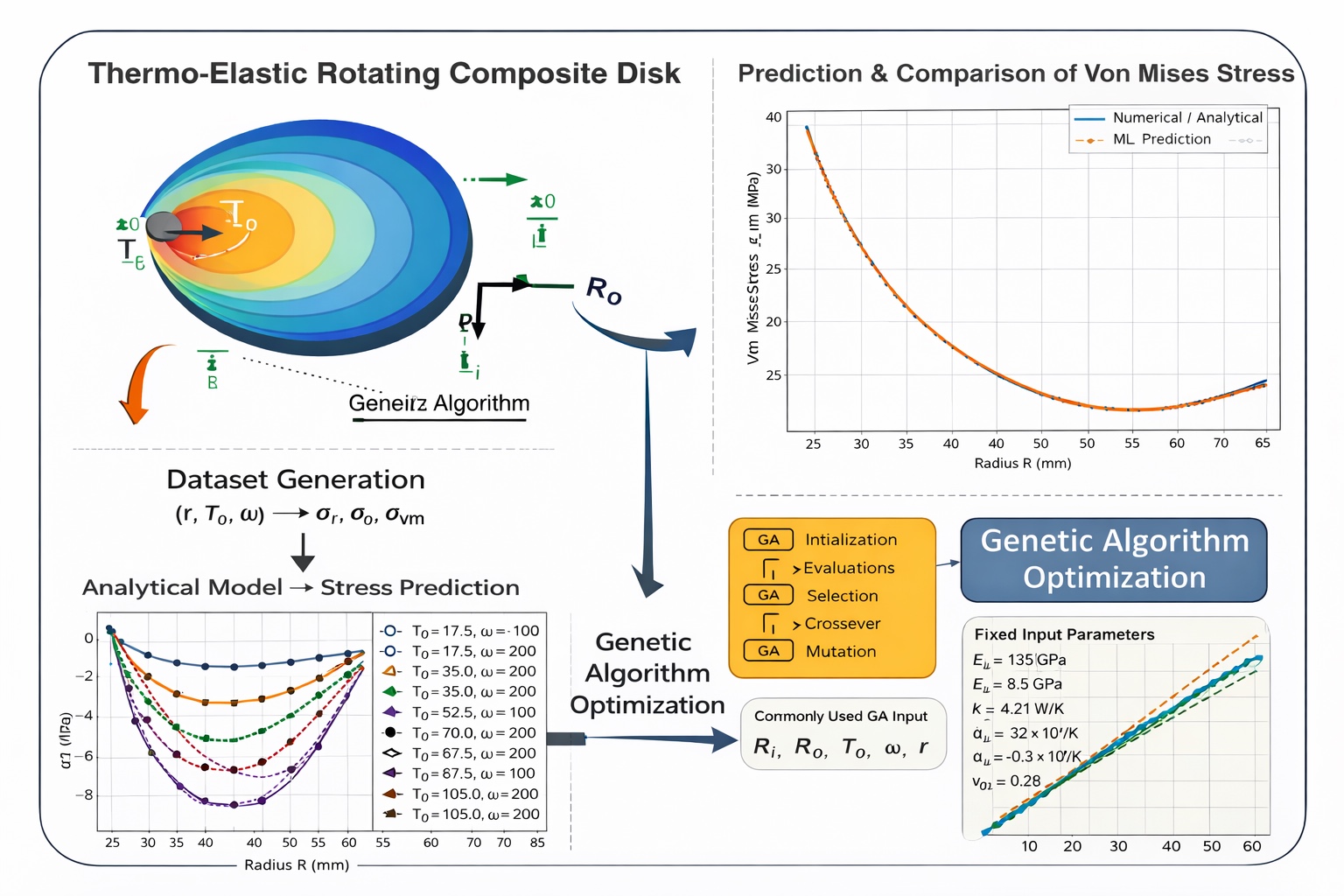
This work presents a robust analytical and computational framework to investigate the thermomechanical behavior of rotating hybrid composites, specifically PAN-based carbon fiber and aramid subjected to high-speed rotation and extreme thermal gradients. By employing plane strain theory, we modeled the structural response of multilayered cylinders to evaluate how angular velocities and temperature fluctuations interact to influence structural integrity. A distinctive feature of this research is the validation of closed-form analytical solutions against machine learning (ML) predictive models at operational speeds of 100 and 200 rad/s, utilizing the Von Mises yield criterion to delineate elastic-plastic boundaries. The results reveal a significant correlation between rotational-thermal synergies and radial displacement, highlighting the unique load-bearing advantages of the carbon-aramid hybrid. While the PAN-carbon phase provides high specific stiffness, the aramid layer enhances toughness and impact resistance. The integration of physics-based modeling with ML validation confirms the framework’s high predictive accuracy and thermal stability. This hybrid approach offers a scalable, intelligent decision-support tool for aerospace and automotive engineering, where lightweight, resilient structural components are paramount for mission-critical performance.
Downloads
Published
How to Cite
Issue
Section
License
Copyright (c) 2026 Firat Kayiran (Author)

This work is licensed under a Creative Commons Attribution 4.0 International License.