Advancing Environmental Sustainability through Artificial Intelligence: A Fuzzy SWOT–LOGSTA-Based Strategic Analysis
DOI:
https://doi.org/10.59543/0zsab542Keywords:
Artificial intelligence; environmental sustainability; SWOT analysis; LOGSTA approach.Abstract
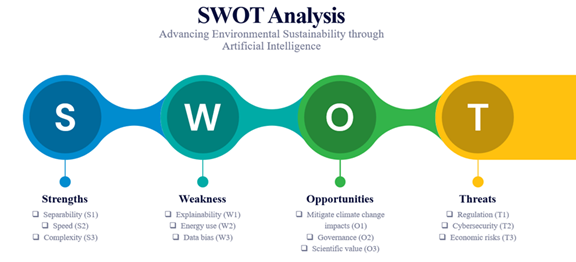
Sustainability has become a major global priority, highlighting goals such as achieving net-zero emissions by 2050, reducing waste, and promoting the use of recycled materials. In response, companies are working to lower carbon emissions and improve resource efficiency. Artificial intelligence (AI) offers strong potential to address these challenges. This study adopted a fuzzy based strategic approach to assess the strengths, weaknesses, opportunities, and threats (SWOT) related to AI role for environmental sustainability. First, 12 SWOT factors are identified based on experts’ opinions and literature review. Then, a fuzzy logarithm normalization and standard deviation (F-LOGSTA) is applied to determine the weight of SWOT factors. The findings indicated that governance, energy use, and economic risks are the most influential factors for promoting environmental sustainability through AI. This study advances understanding of AI in sustainability by offering insights for researchers, practitioners, and policymakers, supporting further work at the nexus of AI and sustainable development.
Downloads
Published
How to Cite
Issue
Section
License
Copyright (c) 2026 Mouhamed Bayane Bouraima, Ibrahim Badi (Author)

This work is licensed under a Creative Commons Attribution 4.0 International License.