Data-Driven Evaluation of Bioactive Glass for pH Regulation in Dental Applications
DOI:
https://doi.org/10.59543/gxr8v281Keywords:
Bioactive Glass; pH Regulation; Decision Modeling; Kinetic Modeling; Dental Materials; Ion Release;Optimization; SimulationAbstract
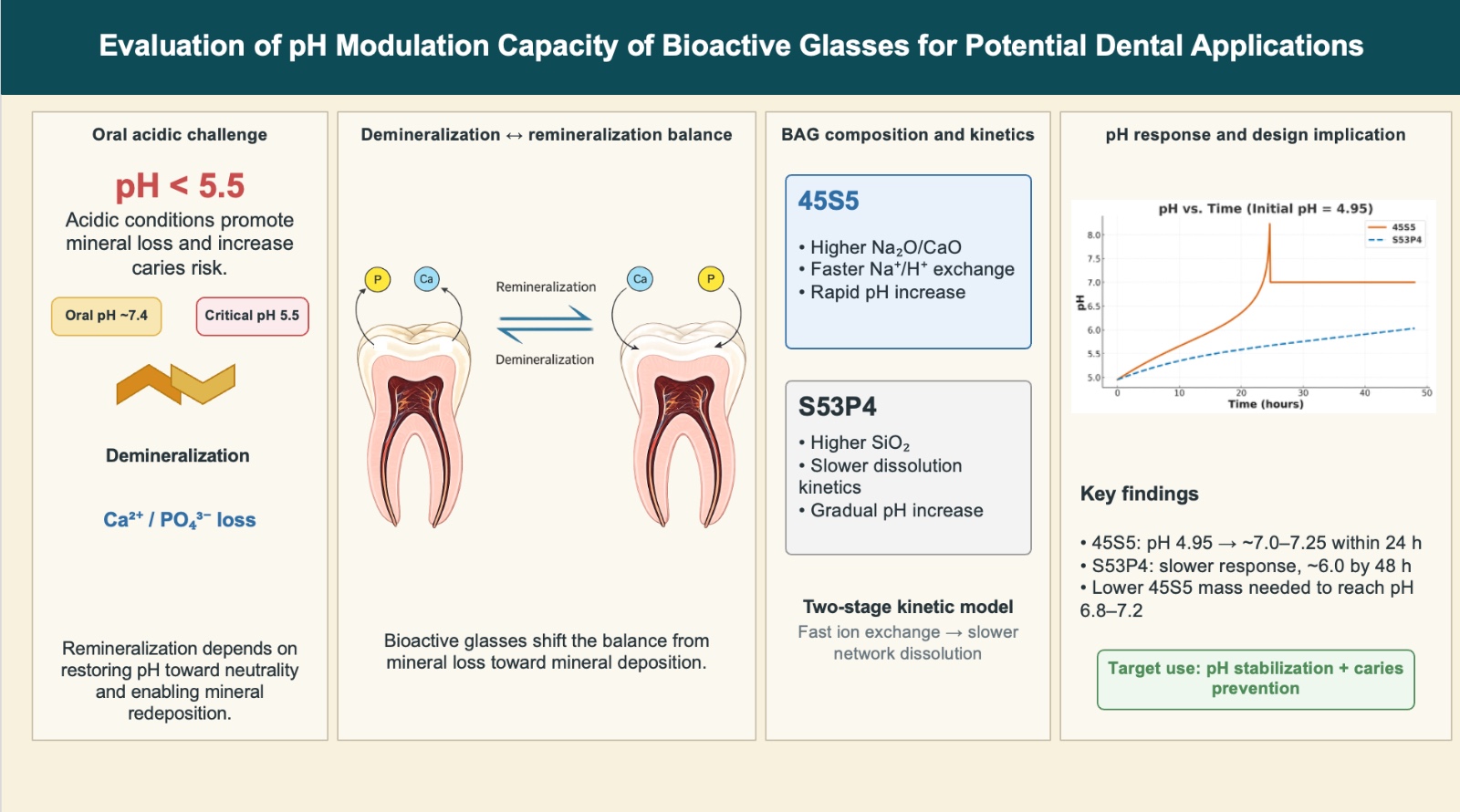
Maintaining physiological pH in the oral environment is essential to prevent demineralization and support natural remineralization processes. Acidic conditions accelerate tissue degradation and increase the risk of dental caries. This study investigates the alkalizing performance of two bioactive glass (BAG) compositions, 45S5 and S53P4, under simulated oral conditions. An integrated experimental and modeling approach was used to evaluate how compositional differences influence pH regulation and to estimate the material dosage required to achieve target pH levels. Experiments were conducted in acidic and neutral media, while a two-stage kinetic model was implemented to simulate ion release and pH evolution. Results show that 45S5 rapidly increases pH from highly acidic conditions to near-neutral levels within 24 hours, whereas S53P4 exhibits slower buffering behavior. Under moderately acidic conditions, both materials improve pH stability, though 45S5 performs more efficiently. The findings highlight the importance of composition-dependent kinetics for optimizing bioactive materials in dental applications.
Downloads
Published
How to Cite
Issue
Section
License
Copyright (c) 2026 Aslıhan Yelkenci (Author)

This work is licensed under a Creative Commons Attribution 4.0 International License.