A Kano-Based Decision Framework for Evaluating Customer Satisfactionin Face-to-Face Banking Services
DOI:
https://doi.org/10.59543/vnr6tp69Keywords:
Customer Satisfaction, Kano Model, Decision Support Systems, Banking Services, Service Quality, Service OptimizationAbstract
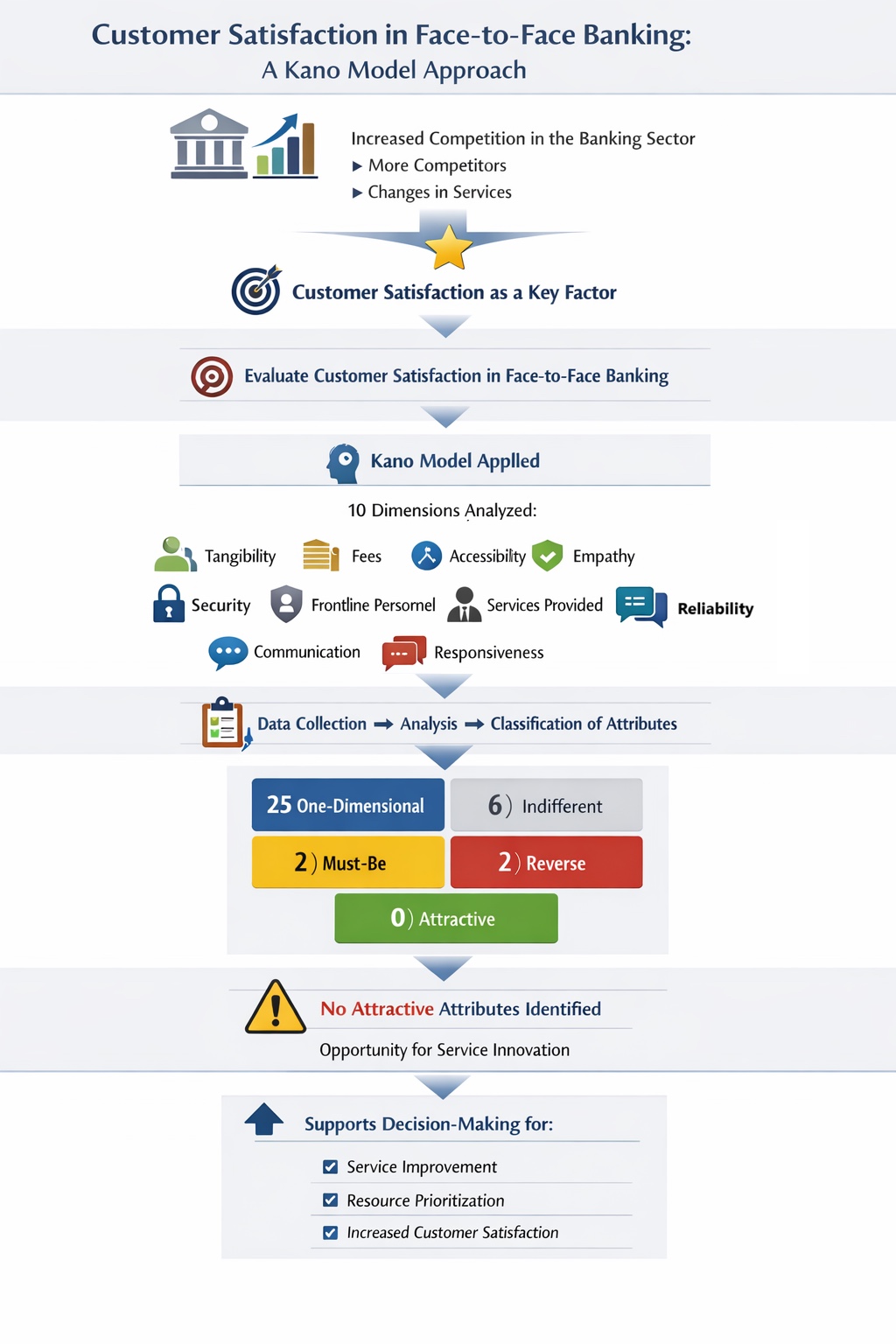
Increased competition among companies in the banking sector is a reality in the current market and is driven mainly by the increase in the number of competitors and significant changes in the services provided. In this context, customer satisfaction is a highly relevant factor. This study aims to evaluate customer satisfaction with face-to-face banking. To this end, the Kano model was used to understand which aspects of in-person banking service impact customer satisfaction, allowing improvements to be prioritized and efforts that are not being effective to identify. The attributes evaluated were aggregated into 10 dimensions – tangibility, fees, accessibility, reliability, empathy, security, frontline personnel, services provided, communication, and responsiveness–defined based on a literature review. Through data collection and analysis, these attributes were classified as one-dimensional, must-be, indifferent, or reverse. Overall, the results showed that 25 attributes were considered one-dimensional, six were classified as indifferent, two were classified as must-be, 2 as reverse, and none of the attributes were classified as attractive. It is expected that this research will contribute to understanding which attributes impact customer satisfaction with in-person banking services and which directions should be taken to improve service quality, thereby increasing user satisfaction.
Downloads
Published
How to Cite
Issue
Section
License
Copyright (c) 2026 Cinthia Monteiro de Santana, Aline Amaral Leal Barbosa, Raíssa Souto Maior Corrêa de Carvalho, Fagner José Coutinho de Melo, Denise Dumke de Medeiros (Author)

This work is licensed under a Creative Commons Attribution 4.0 International License.