Traffic Accidents Analysis and Hotspots Identification Using GIS and Analytical Hierarchy Process: A Case Study of Lahore

Authors

  • Huzaifa Qadeer Center of Excellence in Transportation / Railway Engineering, Pak-Austria Fachhochschule: Institute of Applied Sciences and Technology, Haripur, Pakistan. https://orcid.org/0009-0004-2143-0066 Author
  • Asim Farooq Center of Excellence in Transportation / Railway Engineering, Pak-Austria Fachhochschule: Institute of Applied Sciences and Technology, Haripur, Pakistan. https://orcid.org/0000-0003-1116-0846 Author
  • Danish Farooq Department of Civil Engineering, COMSATS University Islamabad, Wah Cantt Pakistan. https://orcid.org/0000-0003-3403-7744 Author
  • Summera Fahmi Khan Department of Civil Engineering, COMSATS University Islamabad, Wah Cantt Pakistan. https://orcid.org/0000-0001-7280-4460 Author
  • Shahid Noor Jan Department of Civil Engineering, University of Engineering & Technology Peshawar, Bannu, Pakistan. https://orcid.org/0009-0001-8279-2886 Author
  • Daniyal Hussain Department of Civil Engineering, Sarhad University of Science and Information Technology, Peshawar, Pakistan. https://orcid.org/0009-0006-7025-1624 Author
  • Atta Ullah khan Center of Excellence in Transportation / Railway Engineering, Pak-Austria Fachhochschule: Institute of Applied Sciences and Technology, Haripur, Pakistan. https://orcid.org/0009-0009-1592-703X Author

DOI:

https://doi.org/10.59543/0jft4062

Keywords:

Traffic Accidents, Traffic Safety, GIS, Analytical Hierarchy Process, Accident Hotspots, Risk Mapping

Abstract

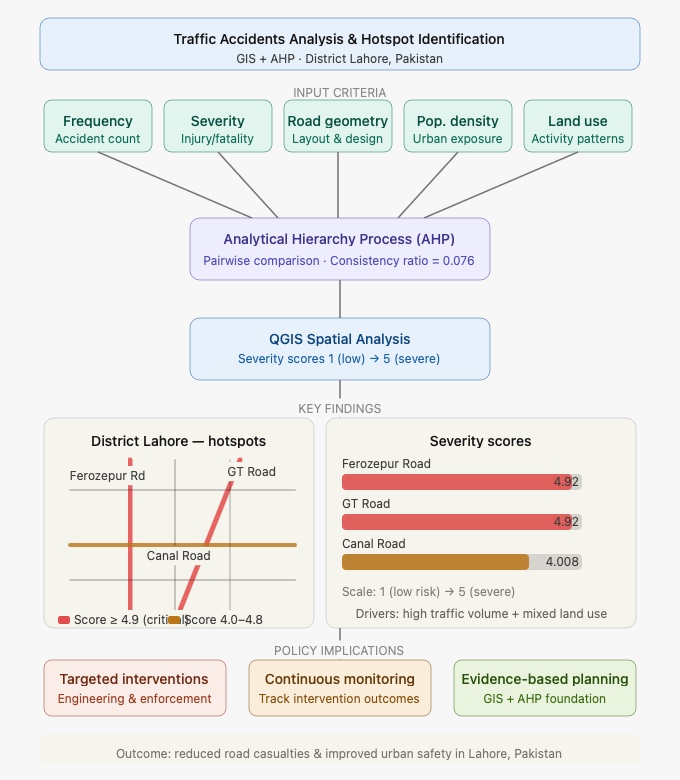
Road traffic accidents are a major health and safety problem in the developing regions. The high rate of casualties annually in Lahore, Pakistan needs to be properly risk-assessed and intervened with safety measures. This paper applies QGIS and Multi-Criteria Decision Making to determine the level of accidents in District Lahore. The Analytical Hierarchy Process uses numerical weights, which represent the frequency, severity, road geometry, population density, and land use patterns, and its consistency ratio is 0.076. GIS classifies the levels of severity between 1 (low) and 5 (severe). Ferozepur Road (4.92), GT Road (4.92), and Canal Road (4.008) become the most dangerous streets since they consistently obtain the highest scores in terms of severity. This has largely been attributed to both high volumes of traffic as well as wide land use along these routes. The results suggest that these places have been causing disproportionately to the accident burden of the district with the consequences being very socio-economic and health-threatening to Lahore. As a way of mitigating these risks, the authorities should immediately join force to roll out specific safety measures, focus on mitigating hotspots that have been identified, and keep track of the results of accidents to ensure their effectiveness. GIS and AHP integration in this study, therefore, offer a strong foundation of evidence-based planning to reduce accidents and casualties.
Author Biographies

  • Huzaifa Qadeer, Center of Excellence in Transportation / Railway Engineering, Pak-Austria Fachhochschule: Institute of Applied Sciences and Technology, Haripur, Pakistan. https://orcid.org/0009-0004-2143-0066

    Research student at Center of Excellence in Transportation/Railway Engineering (COETRE),

  • Danish Farooq, Department of Civil Engineering, COMSATS University Islamabad, Wah Cantt Pakistan. https://orcid.org/0000-0003-3403-7744
    Assistant Professor, Civil Engineering Department

    COMSATS University Islamabad, Wah Campus

  • Summera Fahmi Khan, Department of Civil Engineering, COMSATS University Islamabad, Wah Cantt Pakistan. https://orcid.org/0000-0001-7280-4460
    Assistant Professor, Civil Engineering Department

    COMSATS University Islamabad, Wah Campus

  • Shahid Noor Jan, Department of Civil Engineering, University of Engineering & Technology Peshawar, Bannu, Pakistan. https://orcid.org/0009-0001-8279-2886

    Research Student at UET Bannu 

  • Daniyal Hussain, Department of Civil Engineering, Sarhad University of Science and Information Technology, Peshawar, Pakistan. https://orcid.org/0009-0006-7025-1624

    Department of Civil Engineering, Sarhad University of Science and Information Technology, Peshawar, Pakistan

  • Atta Ullah khan, Center of Excellence in Transportation / Railway Engineering, Pak-Austria Fachhochschule: Institute of Applied Sciences and Technology, Haripur, Pakistan. https://orcid.org/0009-0009-1592-703X

    Research Student at  Center of Excellence in Transportation/Railway Engineering

Downloads

Published

2026-05-04

How to Cite

Qadeer, H., Farooq, A., Farooq, D., Fahmi Khan, S., Noor Jan, S., Hussain, D., & khan, A. U. (2026). Traffic Accidents Analysis and Hotspots Identification Using GIS and Analytical Hierarchy Process: A Case Study of Lahore. Knowledge and Decision Systems With Applications, 2, 524-540. https://doi.org/10.59543/0jft4062

Issue

Section

Articles