A Physics-Grounded Synthetic Data and Machine Learning Surrogate Framework for the Inverse Design of Functionally Graded Scaffolds in Osteochondral Tissue Engineering
DOI:
https://doi.org/10.59543/jccq8g73Keywords:
Physics-informed machine learning; Functionally graded scaffold; Inverse design; Cartilage tissue engineering, Gibson-Ashby modelAbstract
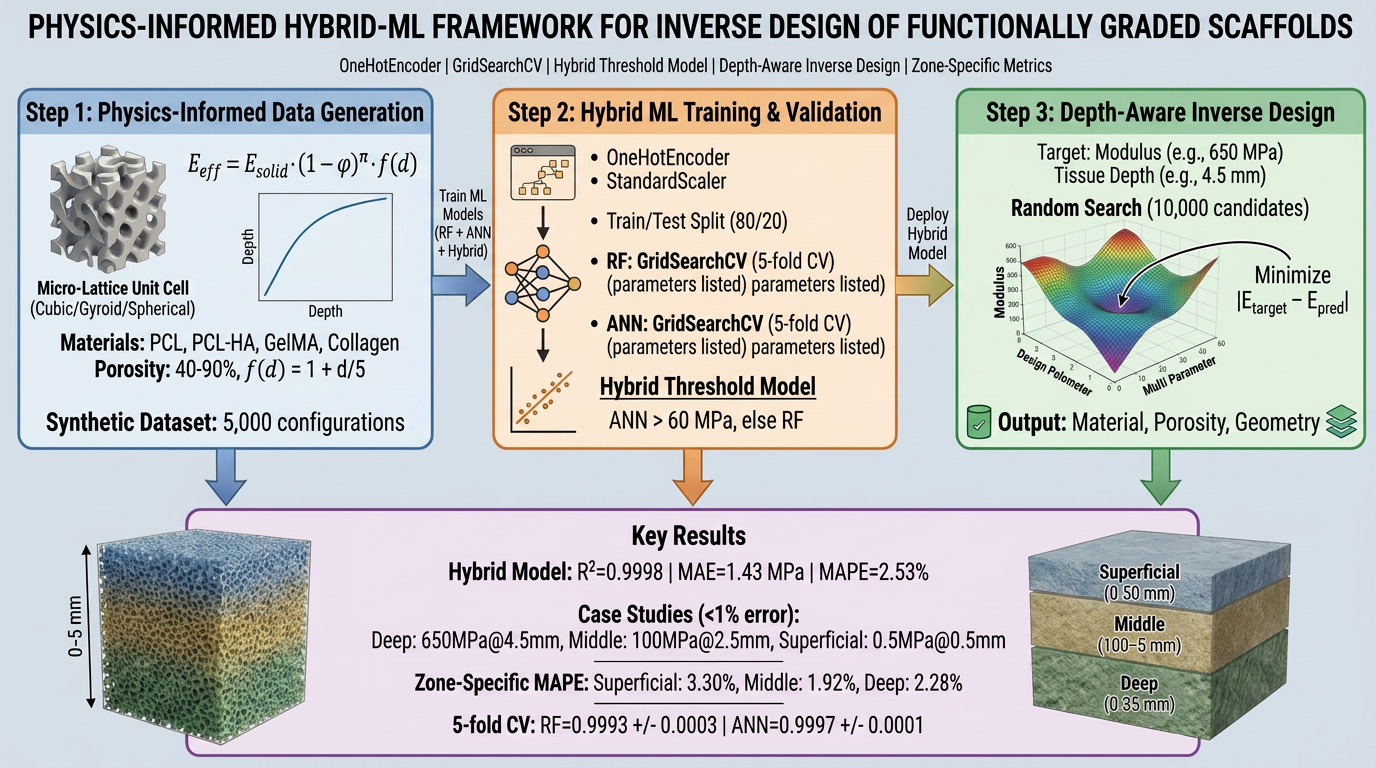
Functionally graded scaffolds for cartilage tissue engineering must replicate the depth-dependent mechanical properties of native tissue, where compressive moduli span approximately four orders of magnitude (~0.02–800 MPa) across the superficial, middle, and deep zones. However, the multi-parametric design space encompassing material composition, porosity, and pore architecture makes systematic experimental optimization prohibitively resource-intensive. We present a physics-grounded Machine Learning (ML) framework (synthetic data generation + surrogate modeling) for the inverse design of functionally graded cartilage scaffolds. A synthetic dataset of 5,000 scaffold configurations was generated using Gibson-Ashby cellular mechanics models, providing physically constrained ground-truth compressive moduli across a broad design space. Random Forest (RF) and Artificial Neural Network (ANN) regressors, with one-hot encoding for categorical variables and 5-fold cross-validation with hyperparameter tuning (GridSearchCV), were trained to predict zone-specific compressive moduli from scaffold design parameters. A hybrid threshold model combining ANN and RF predictions achieved an R2 of 0.9998 Mean Absolute Error (MAE ≈ 1.12 MPa), Mean Absolute Percentage Error (MAPE=2.54%) on held-out synthetic data, demonstrating surrogate fidelity to the analytical generator. A depth-aware inverse design module was subsequently implemented. It prescribes fabrication parameters for user-defined zonal stiffness targets at specified tissue depths. Robustness was confirmed via controlled noise injection and self-consistency validation, ensuring surrogate fidelity beyond circularity concerns. The output is directly correlated to the mechanical gradient that defines natural cartilage. By doing this, scientists can considerably minimize the number of trial-and-error experiments they would have to perform in order to find suitable values for the parameters. The next step will include verification of these hypotheses through physical print tests and evaluation of their performance. Moreover, realistic manufacturing limitations should be taken into account in the process.
Downloads
Published
How to Cite
Issue
Section
License
Copyright (c) 2026 Ahmet Turan Demir (Author)

This work is licensed under a Creative Commons Attribution 4.0 International License.