A BIM-Enabled Framework for Design Continuity and Lifecycle Decision-Making
DOI:
https://doi.org/10.59543/rgq78c34Keywords:
Building Information Modelling; Facilities Management; Design Framework; Decision-MakingAbstract
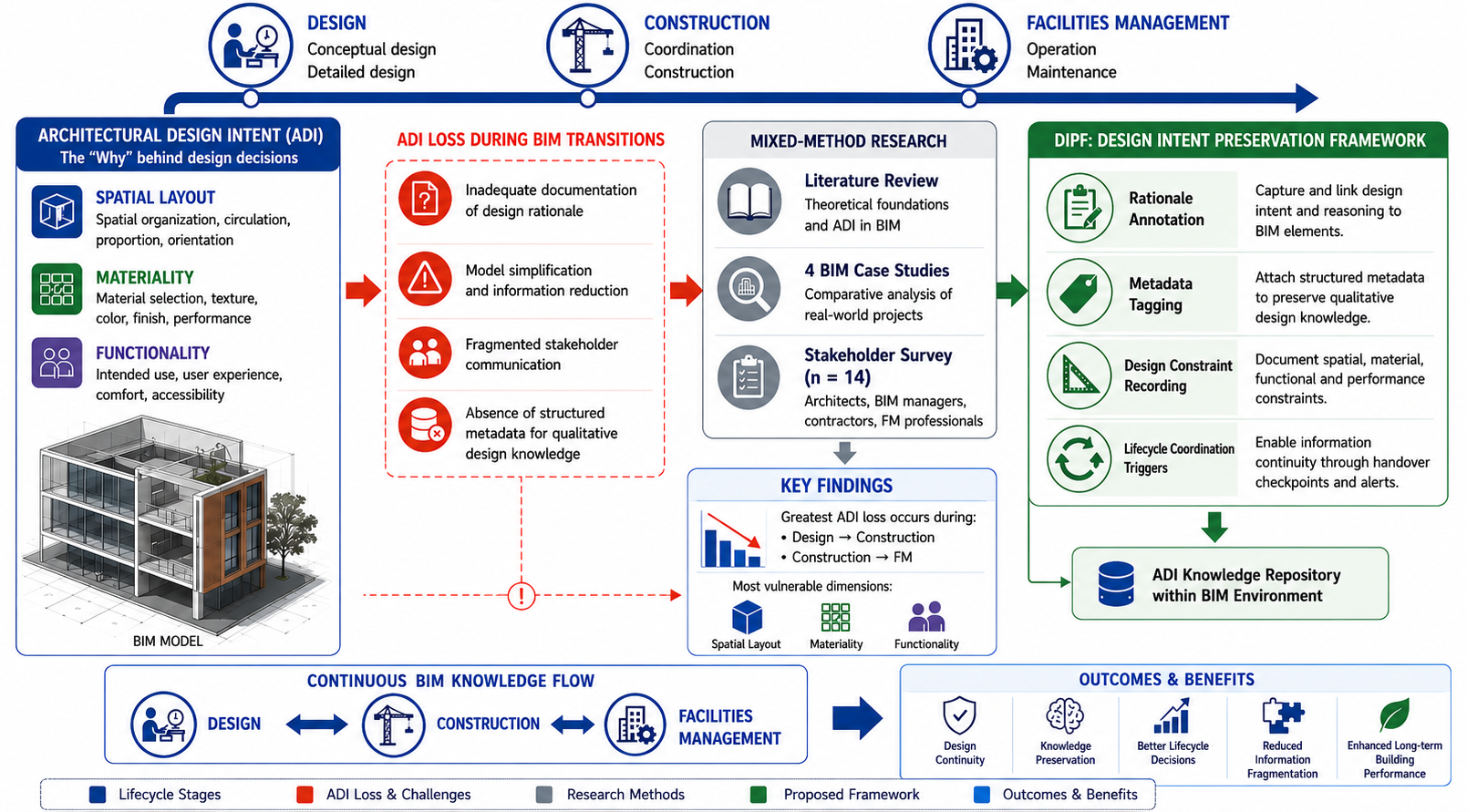
Building Information Modelling (BIM) has evolved into a fundamental platform for lifecycle information management within the Architecture, Engineering, Construction, and Facilities Management (AEC-FM) sector. Despite its effectiveness in supporting technical coordination and information exchange, BIM remains limited in preserving Architectural Design Intent (ADI), particularly the spatial, material, functional, and experiential rationale underpinning design decisions. Consequently, critical design knowledge is often fragmented or lost during transitions between design, construction, and facility management phases, undermining design continuity and lifecycle decision-making. This study investigates how ADI is represented, transferred, and preserved within BIM-enabled workflows and proposes a structured mechanism for maintaining design continuity throughout the building lifecycle. A mixed-methods approach was adopted, combining a systematic literature review, comparative analysis of four documented BIM case studies, and a questionnaire survey involving architects, BIM managers, contractors, and facility managers. The findings reveal that ADI loss occurs predominantly during design-to-construction and construction-to-facility-management transitions. Key causes include inadequate documentation of design rationale, model simplification during handovers, fragmented stakeholder communication, and the absence of structured metadata for capturing qualitative design knowledge. Three principal dimensions of vulnerability were identified: spatial layout, materiality, and functionality. Survey results further demonstrate strong industry recognition of the importance of preserving ADI while highlighting practical implementation barriers, including unclear responsibilities, time constraints, and limited client requirements. To address these challenges, this study proposes a Design Intent Preservation Framework (DIPF) integrating rationale annotation, metadata tagging, design constraint recording, and lifecycle coordination triggers within BIM environments. The framework contributes to lifecycle-oriented BIM research by extending information management beyond technical interoperability toward the preservation of design knowledge, thereby supporting informed decision-making and long-term design continuity.