The Evolving Role of Artificial Intelligence in Decision-Making: A Comprehensive Analysis of Barriers and Challenges
DOI:
https://doi.org/10.59543/43jj2n03Keywords:
Artificial Intelligence (AI); Decision-Making Systems; Science-to-Service Gap; Organizational Change Management; Ethical AI GovernanceAbstract
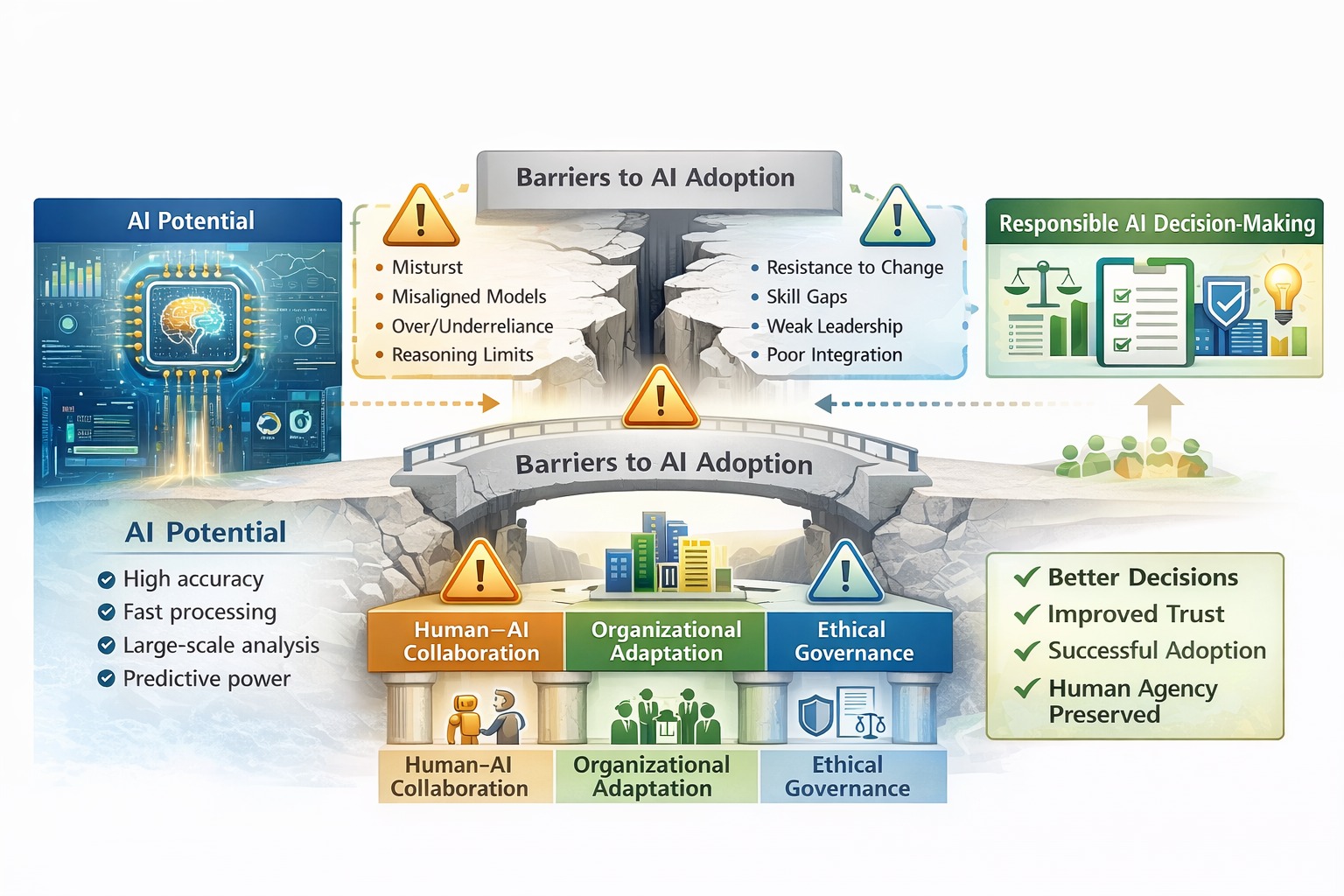
Artificial Intelligence (AI) often suffers from a "science-to-service gap," where high-performing models fail to translate into effective real-world decision-making. This systematic literature review investigates this divide, identifying three critical barriers: inadequate technical reasoning, organizational resistance, and stringent regulatory compliance. To bridge this gap, we propose a holistic analytical framework anchored in three interconnected pillars: the human–AI relationship, predicated on mutual trust and complementarity; organizational preparedness, necessitating comprehensive cultural transformation and workforce reskilling; and ethical regulation, prioritizing process transparency and robust accountability. Our findings reveal that successful AI integration extends beyond technical optimization, requiring cross-disciplinary strategies such as participative design and collaborative human–AI audits. By synthesizing these dimensions, this study provides a strategic roadmap for enterprises to navigate systemic challenges, fostering a transition from theoretical AI potential to actionable, empowered, and human-centric decision-making systems in complex operational environments. Research indicates that proper application of MCDM techniques can relate AI outputs to real-life decision-making by structuring, enforcing transparency, and justifying AI-scoring results for use within an MCDA (Multi-Criteria Decision Analysis) framework, as demonstrated in complex use cases such as transportation planning.
Downloads
Published
How to Cite
Issue
Section
License
Copyright (c) 2026 Karzan Ismael, Ali Mohammed Salih, Zryan Najat Rashid (Author)

This work is licensed under a Creative Commons Attribution 4.0 International License.