Predicting Caffeine-Related Sleep Disruption Using Supervised Machine Learning
DOI:
https://doi.org/10.59543/wkcd4119Keywords:
Caffeine consumption; Sleep quality; Ma- chine learning; Health analytics; Supervised learning; Classification modelsAbstract
Caffeine is one of the most widely consumed psychoactive substances, yet its
effects on sleep remain complex and not fully understood. In this study, we
investigate the relationship between caffeine consumption habits and their im-
pact on sleep quality using machine learning models. For this purpose, we use a
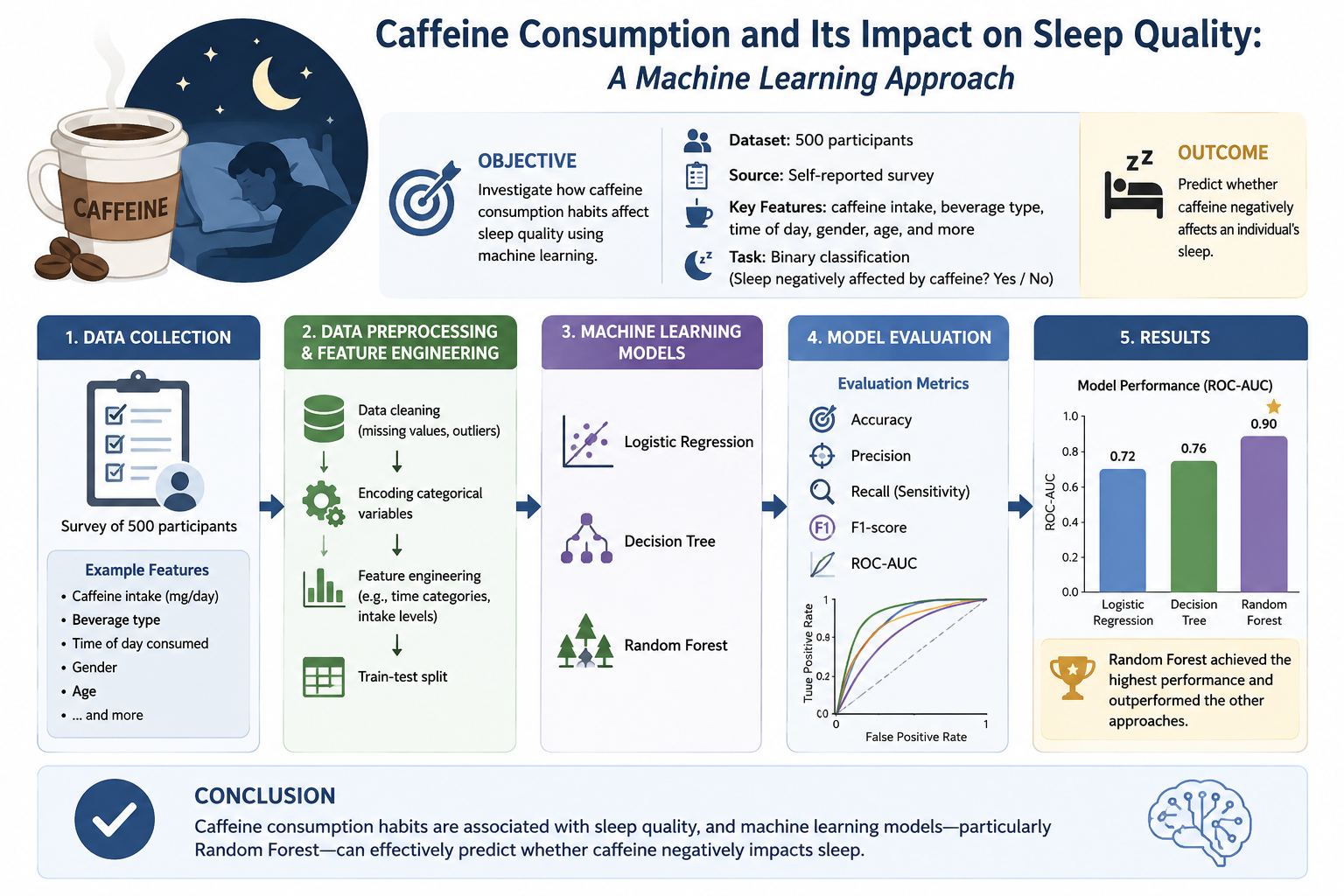
dataset that includes self-reported survey responses from 500 participants, fea-
turing variables such as caffeine intake, beverage type, time of day, gender, and
age. We frame the problem as a binary classification task to determine whether
an individual’s sleep was negatively affected by caffeine. After data preprocess-
ing and feature engineering, we applied and evaluated the performance of three
classification models: logistic regression, decision tree, and random forest. We
assessed model performances using standard metrics such as accuracy, preci-
sion, recall, F1-score, and ROC-AUC. Our results revealed that the random forest
classifier outperformed the other two approaches.
Downloads
Published
How to Cite
Issue
Section
License
Copyright (c) 2026 Zahra Zare, Mumtaz Karatas (Author)

This work is licensed under a Creative Commons Attribution 4.0 International License.