Weapon System Selection for Capability-Based Defense Planning using Lanchester Models integrated with Fuzzy MCDM in Computer Assisted Military Experiment
DOI:
https://doi.org/10.59543/kadsa.v1i.13601Keywords:
Capability-based planning; Weapon Selection; Lanchester models; MCDM; Fuzzy AHP;Abstract
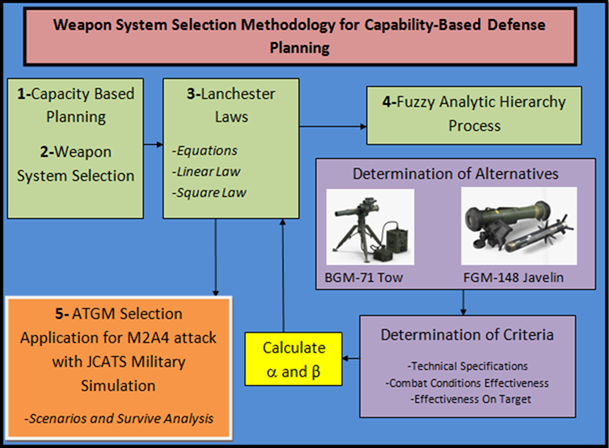
Capability-based planning (CBP) is an approach that is increasingly gaining importance in modern defense strategies. Unlike traditional threat-focused planning, capability-based planning aims to enable countries to develop flexible and sustainable military capabilities against changing security environments. In this context, weapon system selection should be evaluated not only against current threats but also in terms of suitability for possible future operational requirements. The selection of weapon systems requires consideration of a large number of technical, operational and financial criteria. In this process, Fuzzy Multi-Criteria Decision Making (FMCDM) methods are frequently used. In addition, simulation techniques are a critical tool for testing the effectiveness of weapon systems on the battlefield by creating scenarios close to reality. Lanchester equations, in particular, are an effective tool for analyzing the combat dynamics of forces. In this study, an Anti Guided Tank Missiles selection methodology in which the Fuzzy Analytic Hierarchy Process (FAHP) is integrated with Lanchester equations is applied to an example. JCATS was used for computer assisted military experiments scenario analysis. The results show that Lanchester equations are valid.