A Multi-Criteria Utility Approach to Bridge Maintenance Prioritization
DOI:
https://doi.org/10.59543/kadsa.v1i.13625Keywords:
Multi-attribute utility theory; multi-criteria decision making; bridge maintenance planning; bridge prioritizationAbstract
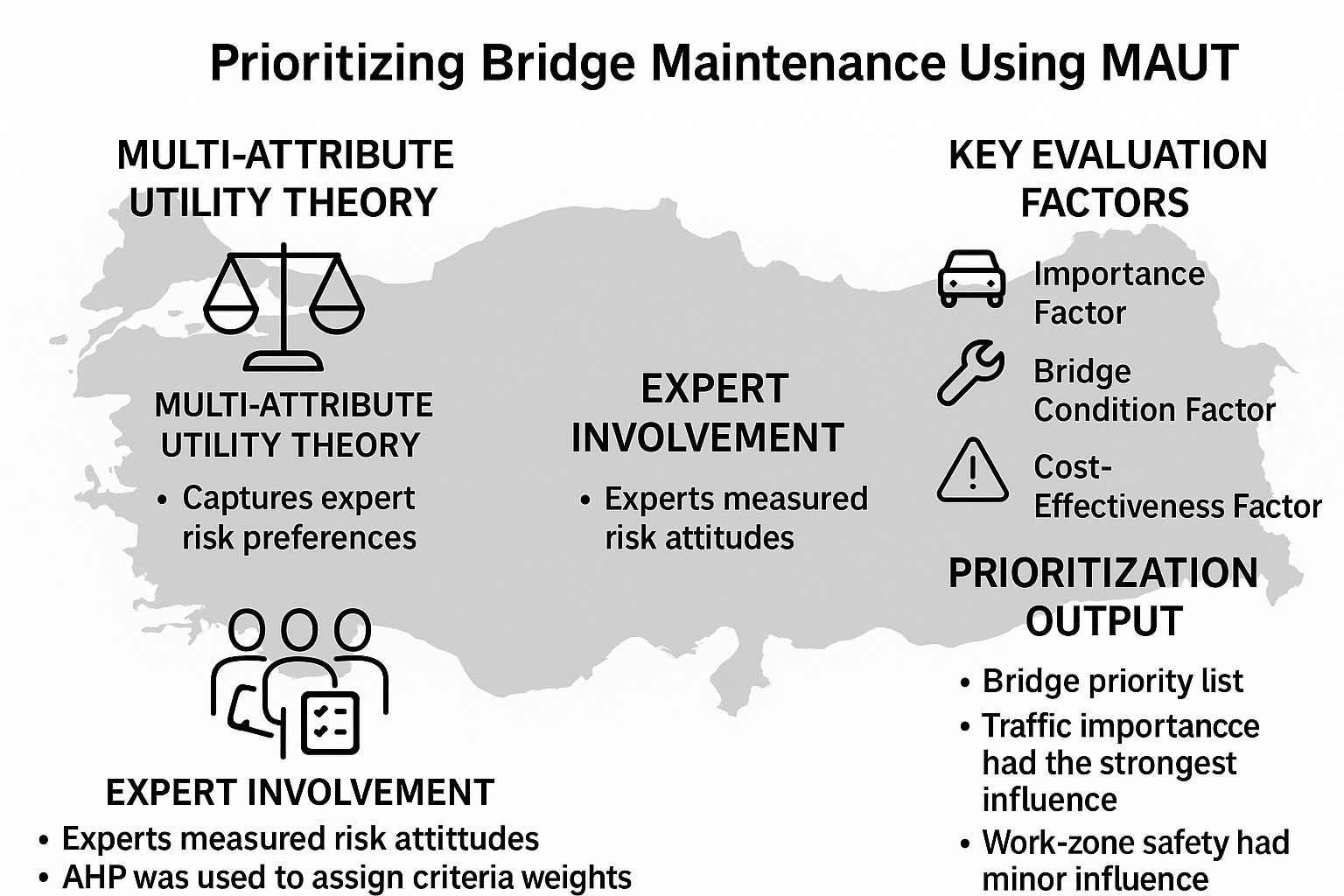
Maintaining bridges optimally presents a challenge for the decision-makers because of the complexity of the objectives. Bridges should have a maintenance planning system for a better organization and controlling mechanism. These systems allow the decision-making process to be performed simpler and the limited public fund to be spent better. In this study, the multi-attribute utility theory (MAUT) is applied as a practical multi-objective decision-making method to prioritize 20 bridge networks in Western Turkey. The objective of this study is to use MAUT to a bridge maintenance problem in Turkey and providing improvements to the existing Turkish bridge management system (BMS) decision-making method in the literature. The criteria list given in the Turkish BMS is reexamined, and one more criterion is added. The current prioritization method is replaced with the MAUT approach to explain the uncertainty situation by taking the risk preferences of the decision-makers. Additionally, the additive utility independence assumption of MAUT is inquired to avoid a suboptimal solution for bridge maintenance planning. The results show that how calculating risk preferences, interrogating more decision-makers with different expertise, and adding a new objective criterion might change the priority order for the same dataset.