An Innovative Decision Support Model for the Financial Performance Assessment: A Study of BIST Cement Firms
DOI:
https://doi.org/10.59543/kadsa.v1i.14021Keywords:
Financial Performance; BIST Cement Sector Firms; MCDM; LOPCOW; MSD; CRADIS, MOOSRA; MAIRCA; Borda Count.Abstract
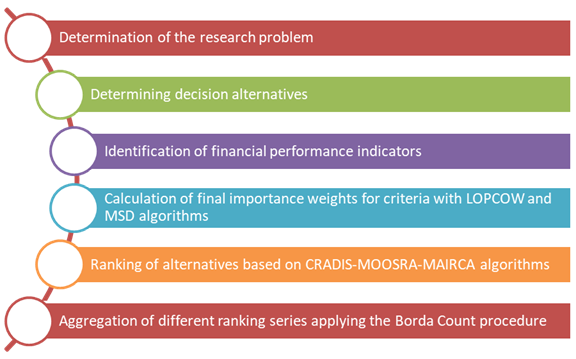
The regularly assessment of the financial performance of firms in the real sector is highly essential, both in terms of increasing the level of operational efficiency and in terms of effectively managing potential risk factors and obtaining sustainable competitive advantage. This paper introduces a new decision algorithm for the assessment of firm performance. This decision algorithm consists of the integration of Logarithmic Percentage Change-driven Objective Weighting (LOPCOW), Modified Standard Deviation (MSD), Compromise Ranking of Alternatives from Distance to Ideal Solution (CRADIS), Multi-Objective Optimization on the Basis of Simple Ratio Analysis (MOOSRA), Multi Atributive Ideal-Real Comparative Analysis (MAIRCA) and Borda Count methodologies. In order to test the presented decision-making procedure, a real-time case study was applied as part of the study. This case study is focused on analyzing the financial performance of 13 cement industry firms whose shares are listed on the Borsa Istanbul (BIST) for the year 2023. In the process of assessing the performance of these companies, 10 performance indicators were selected with the help of previous literature. LOPCOW and MSD algorithms were applied to determine the final importance weights of these indicators, while CRADIS, MOOSRA, MAIRCA and Borda Count algorithms were employed to rank the firms. The findings of the final weighting algorithm indicate that the three most important performance indicators are total debt to total equity ratio, total debt to total assets ratio and cash ratio. Moreover, according to the final ranking results obtained based on the CRADIS, MOOSRA, MAIRCA and Borda Count algorithms, BUCIM is the most financially successful firm in 2023. Additionally, the findings of the robustness analyses also support the conclusion that the results obtained from the presented model are reliable and applicable.