A Multi-Criteria Decision-Making Model for Prioritizing the Causes of Inflation in Libya Using the Best-Worst Method and Analytic Hierarchy Process
DOI:
https://doi.org/10.59543/kadsa.v1i.14259Keywords:
Multi-Criteria Decision-Making; s the Best- Worst Method; Analytic Hierarchy Process; Inflation; policymakingAbstract
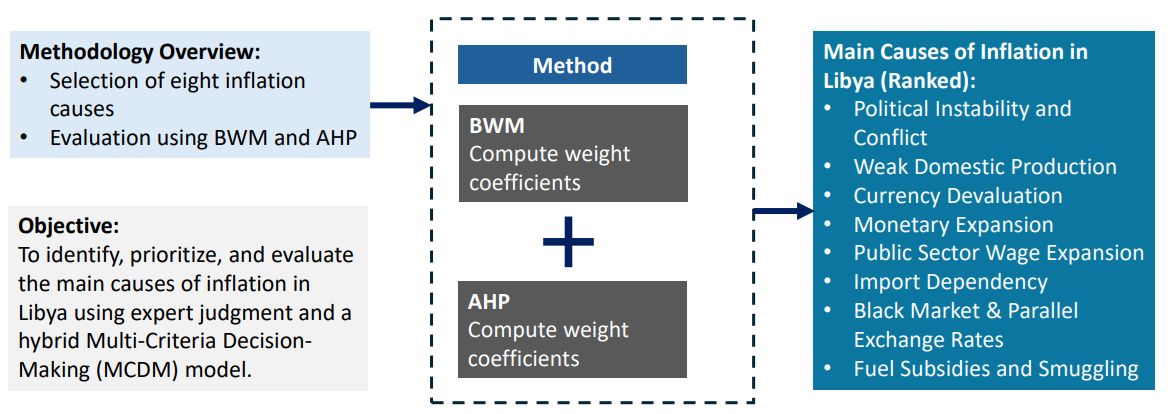
Inflation remains one of the most persistent and destabilizing economic challenges facing Libya, affecting purchasing power, investment, and overall economic stability. Understanding its root causes is essential for designing effective and targeted policy interventions. This study investigates the main drivers of inflation in Libya by applying a hybrid Multi-Criteria Decision-Making (MCDM) approach that combines the Best-Worst Method (BWM) and the Analytic Hierarchy Process (AHP). Eight critical inflation-related factors were identified through expert consultations and economic literature, including structural, monetary, and institutional elements. The BWM was first used to determine initial weight coefficients by comparing the most and least influential factors, followed by the AHP to conduct comprehensive pairwise comparisons. The final weights were derived by aggregating the results from both methods to ensure robustness and consistency. The findings indicate that weak domestic production and political instability are the most significant contributors to inflation in Libya, followed by currency devaluation and monetary expansion. These results emphasize the need for integrated policy responses that not only address monetary dynamics but also confront deeper structural constraints. The study offers a transparent and replicable framework for inflation analysis and contributes to more informed and context-specific economic policymaking in fragile and transitional economies.