Optimizing Cluster Head Selection for Reliable and Efficient WSNs under Uncertainty
DOI:
https://doi.org/10.59543/kadsa.v1i.13875Keywords:
WSNs; Cluster Head; LEACHAbstract
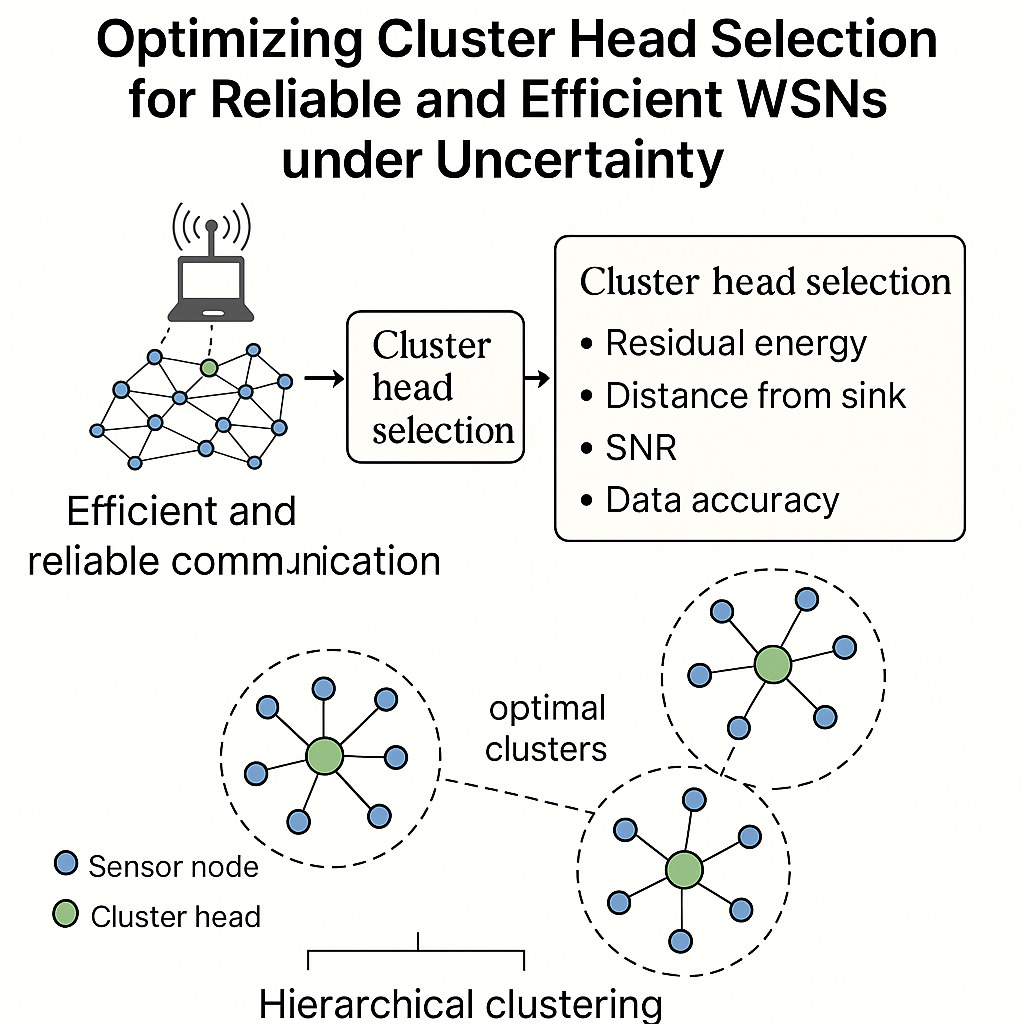
WSNs are often deployed in harsh and challenging environments where nodes may have limited energy and be prone to failure, reliability is an essential component of these networks. Cluster reliability is one of the approaches that can lead WSNs to reliable communication and energy efficiency at the highest degree of order. Cluster reliability is defined as the ability of a cluster to retain its structure and functionality over time, especially in the event of node failures or other unfavourable circumstances. The majority of current clustering protocol-based research focuses on (i) cluster Head Role (ii) cluster formation, (iii) data accuracy, and (iv TDMA schedule creation, all of which entirely ignore the importance of appropriate cluster head selections, which have a significant impact on WSN energy efficiency. The network has been divided into optimum clusters in this study employing a hierarchical clustering agglomerative approach after the optimal number of clusters has been established and confirmed by beta CV cluster validity Indexing. Each node's value is determined by the fitness function proposed in this study using parameters such as (i) residual energy, (ii) distance from sink, (iii) SNR (signal to noise ratio), and (iv) average distance. The weight parameter is determined using the entropy-weighted technique. It has been noted that our suggested method, which is shown in Figure 5, has 20% and 10% longer network lifetimes in comparison to the LEACH and LEACH-FC protocols. Finally, the obtained results have been validated by the testing of statistical hypotheses.