The Utilization of Artificial Intelligence in Healthcare: Review, Challenges, and Future Research
DOI:
https://doi.org/10.59543/kadsa.v1i.15079Keywords:
Artificial Intelligence; machine learning; disease diagnosis; patient monitoring; medical imaging; IOT Devices; CNN; SVM.Abstract
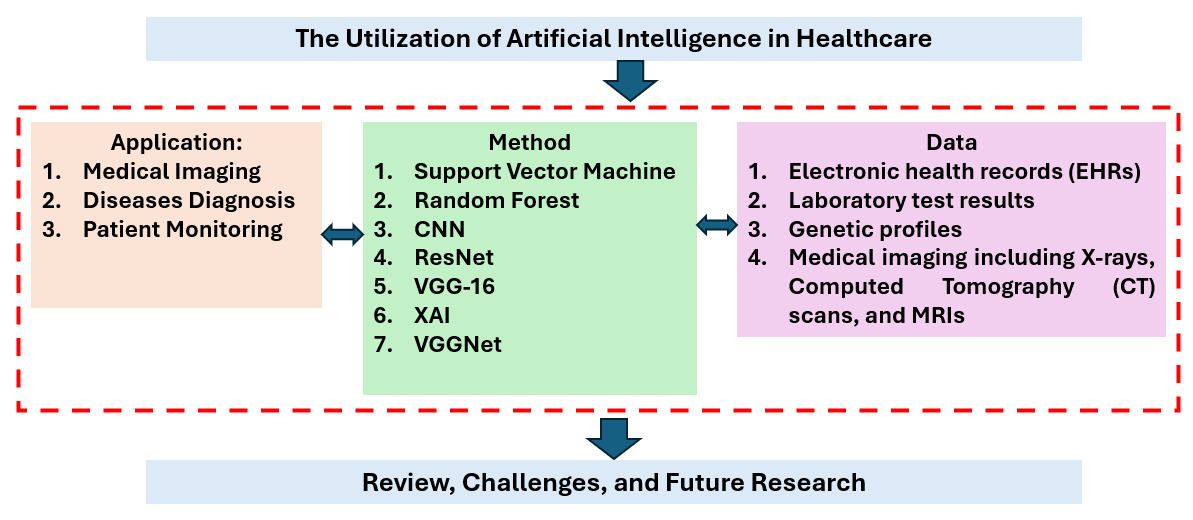
Integrating Artificial Intelligence (AI) into the healthcare system has made major progress for diagnosing disease, patient monitoring, and medical imaging, creating a highly interconnected ecosystem for improved medical decision-making. AI-driven disease diagnosis utilizes machine learning models to analyze vast medical datasets, enabling quick and precise identification of diseases. This diagnostic capability is further enhanced by AI-powered medical imaging, where deep learning techniques, including convolutional neural networks (CNNs), refine image analysis, segmentation, and classification, providing critical support for precise diagnosis. Alongside these deep learning techniques, support vector machines (SVMs) offer strong classification powers that work especially well in situations requiring high-dimensional data processing with sparse training data. By combining CNNs for obtaining features and SVMs for categorizing, the advantages of both methods are combined to increase computational efficiency and diagnostic certainty. These AI-based insights are then reinforced through patient monitoring, where wearable sensors and IoT devices continuously track patient health, feeding real-time data into AI models that detect anomalies and predict disease progression. The synergy between these three areas ensures a continuous flow of medical information, enhancing predictive analytics and personalized treatment strategies. This review examines how powered system AI unifies disease diagnosis and patient monitoring using medical imaging into an integrated healthcare system, discussing current challenges such as data security, interpretability, and clinical adoption. The findings highlight AI's role in bridging diagnostic precision, real-time monitoring, and advanced imaging, paving the way for a more proactive and efficient healthcare framework.